Code at Github
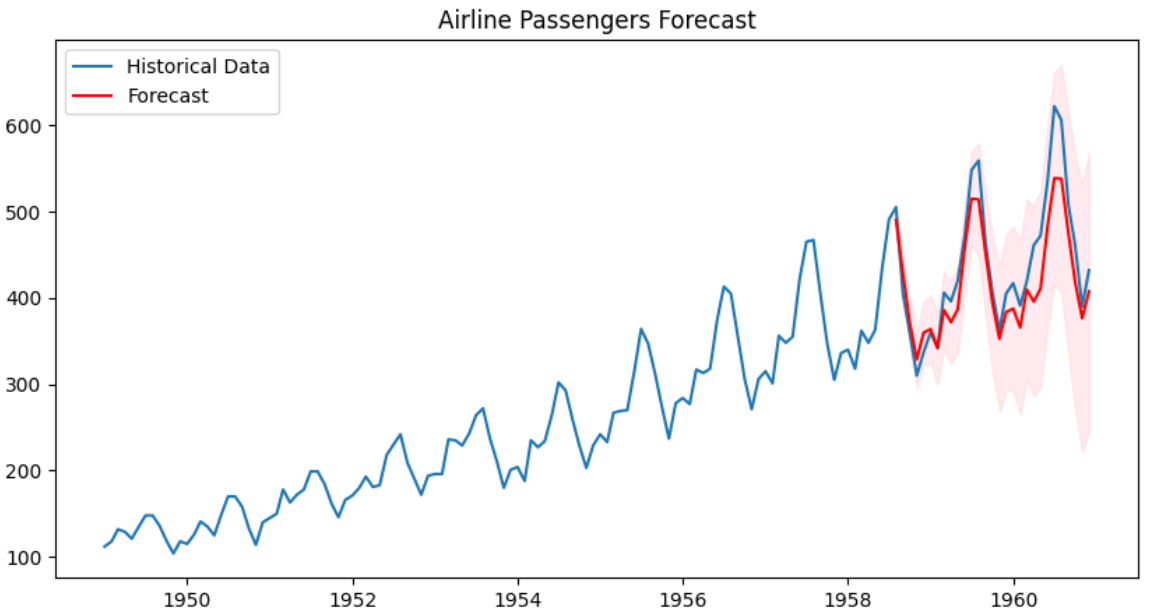
The project aimed to forecast airline passenger numbers through time series analysis. Historical airline passenger data was analyzed using ARIMA modeling to predict future trends. PySpark, integrated within the Databricks platform, was utilized for efficient data processing and manipulation, enabling scalable code as per the dataset's size. This project provided a hands-on experience with advanced time series analysis techniques and developing accurate forecasts. The dataset is from https://github.com/jbrownlee/Datasets/blob/master/airline-passengers.csv.
Methodology
Data was loaded into a Pandas DataFrame, then transformed into a PySpark DataFrame to facilitate scalable processing within Databricks. Databricks was chosen for its seamless integration with PySpark, allowing for the management of extensive historical data (whenever available as the size of the present dataset does not make it mandatory) and providing a collaborative environment for data analysis. Data preprocessing was conducted using PySpark, ensuring clean and structured data for modeling.
The ARIMA model was employed using pmdarima to capture trends and seasonality present in the dataset. The data was split into training and testing sets, with the model trained on the training data and validated on the test data. Model parameters were fine-tuned to enhance predictive accuracy.
Performance Evaluation
Root Mean Squared Error (RMSE): 35.08
Mean Absolute Error (MAE): 28.55
Mean Squared Error (MSE): 1230.80
These metrics demonstrated the model's ability to provide accurate forecasts, while also highlighting areas where further refinement could reduce prediction errors.